Pakistan Accelerates AI Transformation with Education Reforms, Indus AI Week 2026, and Civil Service Training
January 30, 2026 • 2158 Views
Study abroad expert advice
Don't waste time! just fill the form to get help.
Pakistan Fast-Tracks Artificial Intelligence Adoption Across Education, Governance, and Industry
As of January 2026, Pakistan is rapidly advancing its Artificial Intelligence (AI) ecosystem, moving decisively from policy discussions to nationwide implementation. With reforms spanning education, governance, industry, and research, the country is positioning itself as an emerging digital nation driven by intelligent technologies.
Key developments include the introduction of AI as a formal subject in schools, mandatory AI training for civil servants, the launch of Indus AI Week 2026, and expanding research in areas such as autonomous vehicles and machine learning.
AI Formally Introduced in School Curriculum
One of the most significant developments is the inclusion of Artificial Intelligence as a formal subject in the school curriculum under the Islamabad Federal Directorate of Education (FDE). Starting in April 2026, AI education will be rolled out across schools and colleges in a structured, age-appropriate manner.
Under the new framework:
- Nursery to Class 5: AI will be taught as a non-credit “learning with fun” subject, focusing on digital awareness, creativity, and problem-solving.
- Grades 6 to 8: Students will choose between Computer Science and Artificial Intelligence, allowing early specialization.
- Grades 9 to 12: AI will be available as an elective subject, preparing students for higher education and technology careers.
This initiative represents a shift toward skill-based education and is expected to expand to other provinces following initial implementation in Islamabad.
Indus AI Week 2026: Building a National AI Ecosystem
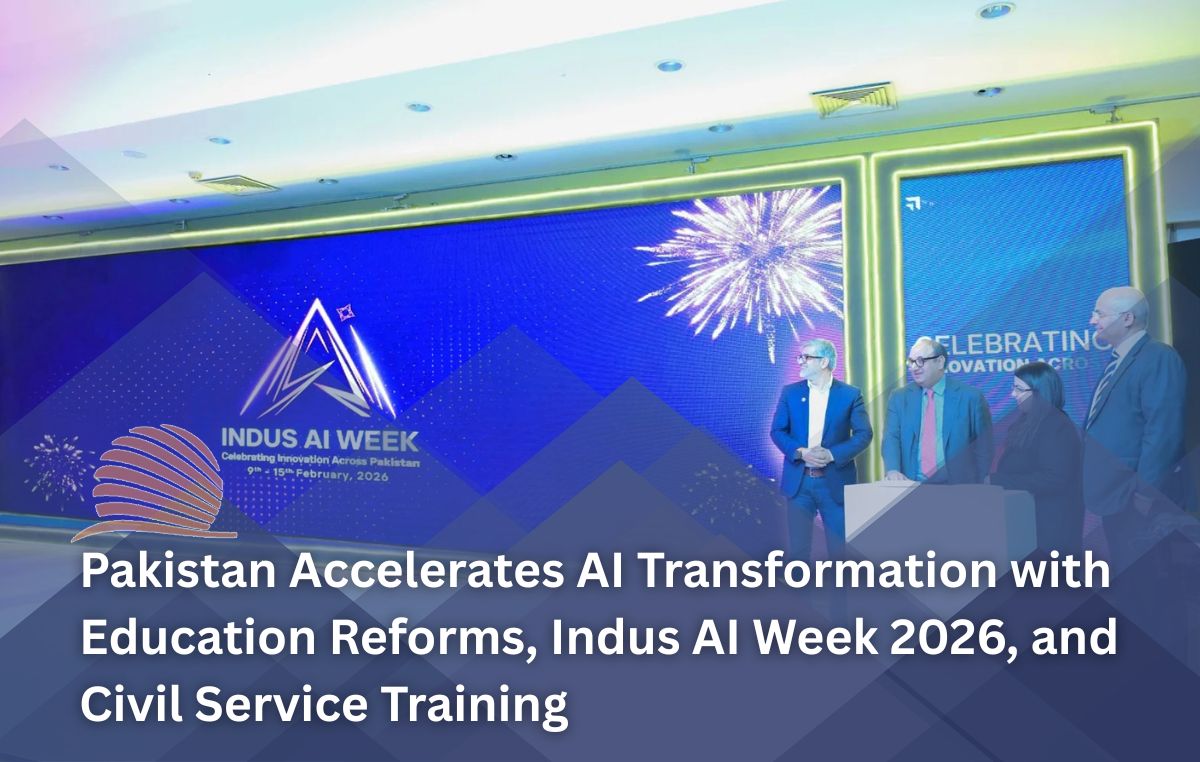
To accelerate AI adoption nationwide, the government has announced Indus AI Week 2026, scheduled to take place from February 9 to 15, 2026. The event aims to serve as a national platform bringing together policymakers, startups, researchers, investors, and global technology leaders.
Indus AI Week will focus on:
- Strengthening Pakistan’s AI capabilities
- Promoting AI-driven innovation across sectors
- Connecting startups with industry leaders
- Encouraging public-private partnerships
The initiative reflects the government’s intent to foster collaboration and create a sustainable AI ecosystem aligned with international standards.
Mandatory AI Training for Civil Servants
In a major governance reform, the Federal Government has made AI training compulsory for all future civil servants. The “AI 101” course, now mandatory at the Civil Services Academy, aims to modernize public administration through data-driven decision-making.
The training focuses on:
- Ethical use of Artificial Intelligence
- Automation in government processes
- Evidence-based policymaking
- Responsible handling of data and digital tools
Officials believe this move will enhance efficiency, transparency, and innovation in public service delivery.
AI Research and Innovation: Autonomous Vehicles
Pakistan’s AI ambitions extend into advanced research and development. At NED University in Karachi, researchers are actively developing AI-driven autonomous vehicles. The project includes real-time vehicle control, lane detection, and intelligent navigation systems.
Ongoing tests demonstrate progress in driverless technology, highlighting the growing role of academic institutions in applied AI research and innovation.
AI Education Focus and Teacher Training
The AI curriculum across Pakistan is designed to emphasize practical and industry-relevant skills rather than purely theoretical concepts. Core focus areas include:
- Computational thinking
- Robotics design and automation
- Machine learning and data analytics
At the university level, BS in Artificial Intelligence programs now include advanced subjects such as:
- Machine learning
- Natural language processing (NLP)
- Computer vision
- Neural networks
To support this expansion, the Higher Education Commission (HEC) has partnered with Meta and Atomcamp to train over 300 university faculty members in AI-related disciplines, strengthening teaching capacity nationwide.
Strategic Vision Under National AI Policy 2025
All these initiatives align with the National Artificial Intelligence Policy 2025, approved by the Federal Cabinet. The policy serves as a roadmap for ethical, inclusive, and sustainable AI adoption, with the goal of transforming Pakistan into a knowledge-based economy.
According to policy projections:
- AI and digital technologies could increase exports by $6.6 billion annually by 2030
- The digital economy could expand by Rs 2.8 trillion
- AI-led innovation will play a central role in economic growth and competitiveness
Industry Trends and AI Adoption
Pakistan’s private sector is also embracing AI at a growing pace. Startups are developing AI-powered solutions in:
- Banking and financial services
- Healthcare diagnostics and management
- E-commerce and customer analytics
Businesses are increasingly adopting AI tools for productivity, particularly in AI-powered search, language processing, and automation, reflecting a shift toward smarter workflows.
Conclusion: Toward a Digital Nation Pakistan
The rapid acceleration of Artificial Intelligence adoption in Pakistan marks a turning point in the country’s development journey. From classrooms to civil services, research labs to industry, AI is becoming a foundational element of national progress.
With strong policy backing, educational reforms, and international collaboration, Pakistan is advancing toward its vision of a “Digital Nation Pakistan” by the end of the decade—one where innovation, skills, and technology drive inclusive growth and global relevance.









.png)